Part 1
What is Misinformation
Misinformation and disinformation are often conflated under a shared umbrella, however, it is critical to understand they are vastly different: in creation, sharing, and intention. Misinformation should not be viewed as ‘innocent’ or unintentional; it is not the lesser of two evils.
Takeaways
1
Misinformation differs from disinformation in that it's shared by people who believe it to be true, yet it remains intentional and designed to provoke emotional responses.
2
The sharing of misinformation serves to telegraph worldviews and reinforce in-group belonging, making it a tool for social identity.
3
Repetition and widespread sharing of misinformation can lead to its acceptance as fact within communities, regardless of its validity.
4
Identifying misinformation requires checking for emotional language, cherry-picked data, false equivalencies, and out-of-context information.
Misinformation is information that is false, misleading, or out-of-context. It is emotive, intentional, and designed to provoke a response. It is a deliberate act regardless of whether the information is false or valid. It is shared by those who believe it to be correct.
Fundamentally, the sharing of misinformation is about telegraphing a view of the world. In this sense, people who share misinformation do it because it conforms to their view of the world and they identify with the piece of information. They are widening and normalising a specific idea by sharing it with people of the same view. When misinformation is shared, the more it is repeated and the more people share and believe it, the more ‘factual’ misinformation becomes.
I shared something which resonates with me and will further unify my in-group who share my beliefs, it signals both my affirmation of belonging to a group who think like me and my acceptance by that group, when shared by others
Candyce Kelshall
Misinformation Example: Covid-19
While studies demonstrate that the chances of dying from Covid-19 are higher in those who are obese and over 65, it is misleading and incorrect to claim that non-obese people and those under 65 face no risk from Covid-19.
Despite the fact that there does exist a link between Covid-19 deaths and obesity, according to Professor John Wilding of the World Obesity Federation, stating that people who aren't obese aren't at risk is a "complete fallacy."
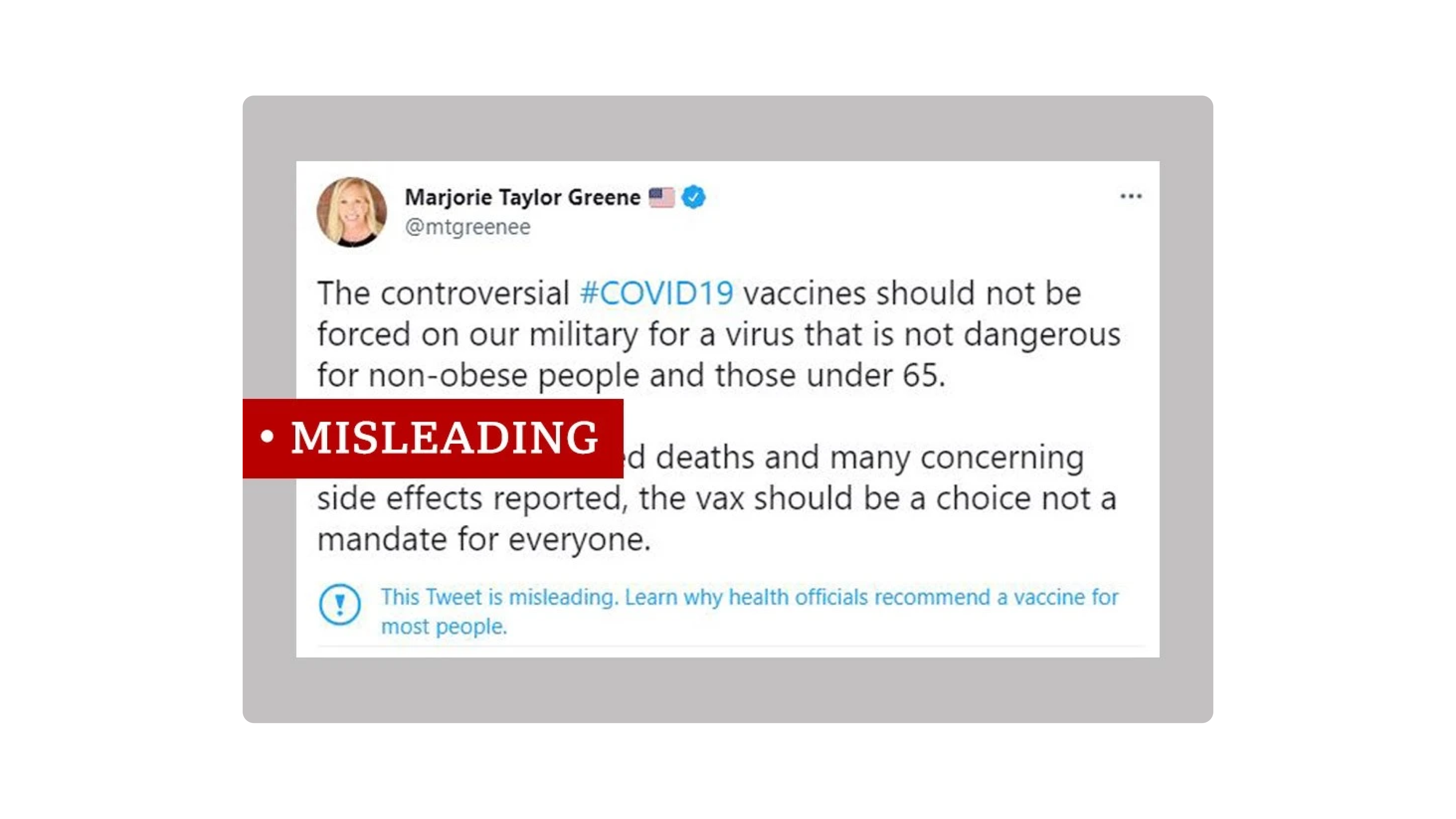
Misleading Tweet from Majorie Taylor Greene highlighted by the BBC https://www.bbc.co.uk/news/57941113
Checklist
- Tone CheckIs there emotive language?
- Info QualityIs the information cherry-picked, incorrect, or invalid?
- WhataboutismsAre there false equivalencies?
- Check IntentIs the information persuasive or designed to make you feel something?
- Bias ReviewIs the author/source presenting a polarised perception?
- Context ReviewDoes it cite out-of-context information? Are there sweeping statements or generalisations?
Further Reading
Nature: How prevalent is AI misinformation? What our studies in India show so far
Google is not ‘just’ a platform. It frames, shapes and distorts how we see the world
America Psychological Association: What employers can do to counter election misinformation in the workplace
NPR: How do you counter misinformation? Critical thinking is step one
The Conversation: How AI bots spread misinformation online and undermine democratic politic
X’s AI chatbot spread voter misinformation – and election officials fought back